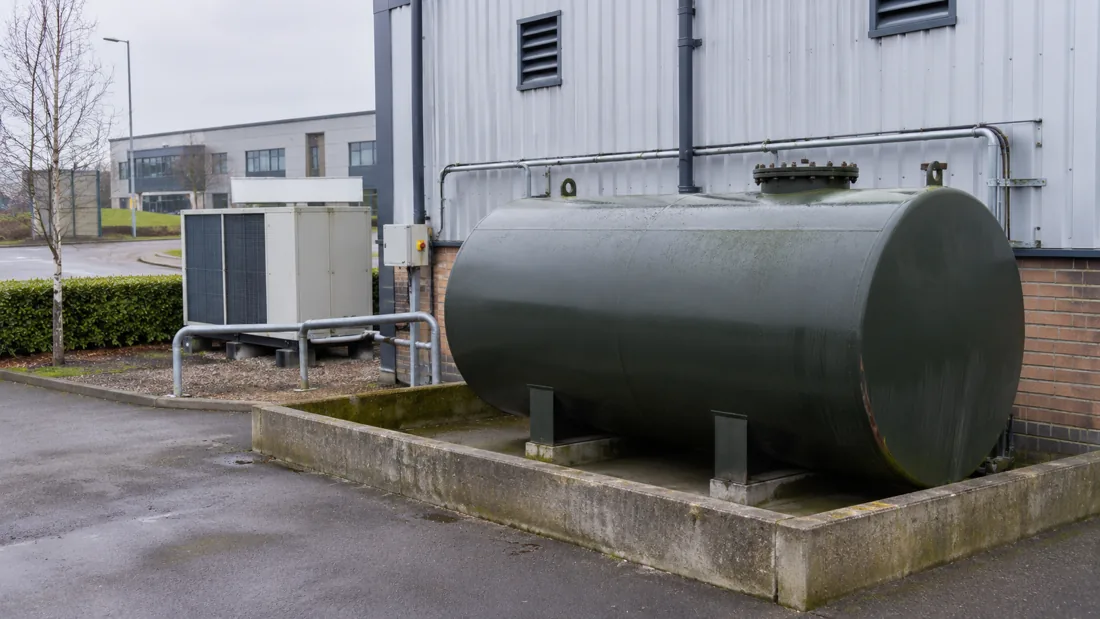
When Removal Is The Right Decision
A redundant tank can stand between an engineering business and a useful piece of floor space. Removal may follow a heating change, a failed inspection, a workshop refit or a property handover. The right scope depends on whether the tank alone is leaving or whether the surrounding fuel system is being retired too.
A visible above-ground tank is only part of the picture. Fill cabinets, buried supply lines, vents, pumps and supports can remain after the vessel has gone. Identify what the final area needs to look like before agreeing a removal, particularly where another contractor will use the space immediately afterwards.
Whole Lift Or Sectional Removal?
A whole lift can suit a sound tank with a clear route to a suitable loading position. Its dimensions, lifting points and condition still need checking. An empty vessel can be awkward to handle, and a nominal capacity is not a reliable statement of lifting weight.
Sectional removal may be considered where a tank was installed before walls or doorways were completed. The smallest doorway, a turn in a corridor or overhead services can decide the method. Cold cutting is a specialist operation following preparation and assessment, rather than permission to cut an unprepared tank.
For a basement or enclosed workshop, send photographs showing the complete exit route. A picture of the tank front does not reveal a narrow stair, low beam or shared loading bay. The survey should resolve those constraints before equipment and transport are booked.
Fuel First, Steel Second
Remaining fuel affects the programme, temporary storage and waste arrangements. State the most recent gauge reading, when it was taken and whether the tank is still feeding equipment. A reading can be uncertain, particularly in an old tank containing water and settled deposits.
Recoverable fuel may be transferred into suitable storage if its condition and the receiving system allow. Sludge, water and unusable product need a separate decision. Mixing them into otherwise usable fuel can increase disposal volumes and remove an opportunity for recovery.
The removal sequence starts with agreed shutdown and isolation, followed by liquid recovery, cleaning and atmospheric assessment appropriate to the work. Lifting or cutting follows only when the preparation and controls are suitable. Do not open, disconnect or attempt to empty a tank to prepare for a quotation.
Lifting At An Occupied Workshop
A crane position must be assessed against the load, reach and ground conditions. A hard-looking yard can contain buried services, chambers or weak covers. Include any available drainage and utility drawings, and identify adjoining land that is outside your control.
Workshop deliveries, forklift routes and pedestrian entrances may cross the proposed work area. Agree separation and a working window with the person controlling the premises. The plan should also address parked vehicles, overhead cables, neighbouring buildings and access for the collection vehicle.
HSE guidance on LOLER explains the need for competent planning, appropriate supervision and safe execution of lifting operations. Ask who is responsible for the lift plan and site preparation. Do not assume those responsibilities transfer simply because a crane is hired.
What Changes The Quotation
The main cost drivers are tank size and construction, fuel and sludge quantities, cleaning requirements and the removal method. Restricted access can add handling stages, specialist cutting or longer occupation of the site. Transport arrangements also change with the dimensions and weight of the load.
Specify whether the price includes pipework, bund demolition, excavation, base removal or making good. These are separate tasks and are not automatic parts of taking away a vessel. Where buried contamination is suspected, an environmental investigation may need its own scope before the area is released for redevelopment.
Your Enquiry And Handover File
Send the postcode, tank material, approximate dimensions and capacity, last stored product and estimated contents. Add safe, ground-level photographs of the tank, connections, access gates and loading position. Include the desired completion date, occupancy restrictions and any survey or inspection already available.
Agree the records before work begins. Relevant documents can include site-specific risk assessments and method statements, a lift plan, a completion or disposal record and waste documentation matching each stream. Hazardous waste uses consignment documentation where applicable, while non-hazardous transfers have their own records.
Atmospheric or gas-free records relate to the conditions and work assessed, rather than providing permanent permission for future cutting. Retain the removal record with your premises file. If a tank is left in position instead, record that accurately and consider the separate decommissioning service.
Your Questions Answered
Can A Tank Be Removed Through A Small Door?
Tank removal through a small door may require controlled sectional dismantling after isolation, liquid recovery and cleaning. The survey needs the full route, including turns and ceiling height. Do not remove doors or structural elements in anticipation of a method. The quotation should identify any enabling work and who is responsible for it.
Does Removal Include The Remaining Diesel?
Remaining diesel needs to be included explicitly in a tank removal quotation. Its volume and condition determine whether recovery, transfer or disposal is appropriate. Tell us if another tank could receive usable fuel, but do not arrange a transfer yourself. Sludge and water may need separate handling from the recoverable product.
Planning references: HSE confined spaces, DSEAR guidance, business waste responsibilities. Requirements depend on the assessed work.